
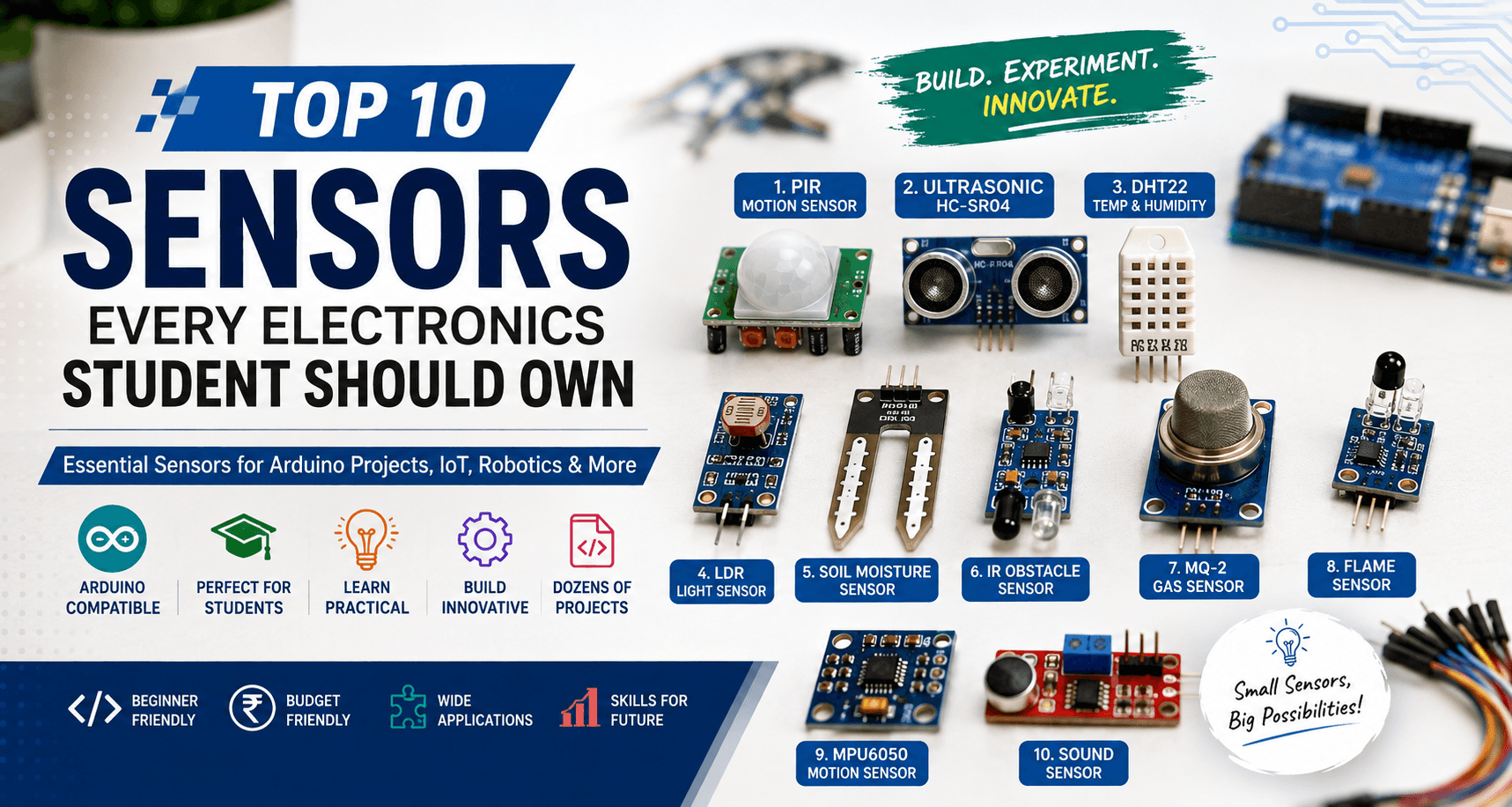
Top 10 Sensors Every Electronics Student Should Own
Looking for the best Arduino sensors for electronics projects? Here are 10 essential sensors every electronics student should own, from PIR and ultrasonic sensors to DHT22, LDR, and soil moisture sensors.
Whether you are studying electronics engineering, electrical engineering, computer engineering, mechatronics, or IoT, sensors are an essential part of practical electronics.
A good collection of Arduino sensors allows you to build projects that can detect motion, measure distance, monitor temperature and humidity, detect light, measure soil moisture, and interact with the surrounding environment.
Instead of buying dozens of modules, students can start with a small collection of versatile sensors and gradually expand their electronics toolkit.
In this guide, we cover the top 10 sensors every electronics student should own, explain how each sensor works, and suggest practical projects you can build with them.
Why Should Electronics Students Learn About Sensors?
Sensors allow an electronic system to understand what is happening around it.
For example:
A PIR sensor detects human movement.
An ultrasonic sensor measures distance.
A DHT22 measures temperature and humidity.
An LDR detects changes in light.
A soil moisture sensor detects moisture in soil.
A gas sensor can detect certain gases.
A IR sensor can detect objects or infrared signals.
When combined with a microcontroller such as Arduino Uno or ESP32, these sensors can become complete automation and IoT systems.
The basic concept is:
Physical Environment → Sensor → Microcontroller → Processing → Output
This is one of the most important concepts for students learning embedded systems and automation.
Top 10 Arduino Sensors Every Electronics Student Should Own
Here are our recommended 10 essential sensors for electronics students and Arduino beginners.
1. HC-SR04 Ultrasonic Sensor
The HC-SR04 ultrasonic sensor is one of the most useful sensors for Arduino projects.
It measures distance using ultrasonic sound waves.
The sensor sends an ultrasonic pulse and measures the time taken for the echo to return.
Arduino can then calculate the approximate distance between the sensor and an object.
Key Features
Non-contact distance measurement
Simple Arduino interface
Low cost
Easy to program
Excellent for beginner projects
Typical Applications
Obstacle detection
Robot navigation
Automatic doors
Parking sensors
Water-level monitoring
Smart dustbins
Security systems
Project Ideas
Try building:
Automatic Smart Dustbin
When a person brings their hand near the sensor, a servo motor automatically opens the lid.
Another excellent project is an:
Ultrasonic Parking Assistant
The system measures the distance between a vehicle and an obstacle and provides a warning when the vehicle gets too close.
What Students Learn
Using the HC-SR04 helps students understand:
Trigger and echo signals
Time measurement
Digital I/O
Distance calculation
Microcontroller programming
2. PIR Motion Sensor
The PIR (Passive Infrared) sensor is designed to detect movement from people and other warm objects.
PIR sensors detect changes in infrared radiation within their field of view.
One of the most common modules used by Arduino beginners is the HC-SR501 PIR sensor.
Key Features
Motion detection
Digital output
Adjustable sensitivity on many modules
Adjustable delay on many modules
Low-cost solution
Applications
PIR sensors are commonly used in:
Automatic lighting
Security alarms
Smart homes
Motion-activated systems
Energy-saving systems
Automatic doors
Project Idea
Automatic Room Light
Person enters room
        ↓
PIR detects motion
        ↓
Arduino processes signal
        ↓
Relay activates
        ↓
Light turns ON
This is a simple but practical project for learning automation.
What Students Learn
Digital sensor signals
Motion detection
Relay control
Automation logic
Energy-saving applications
3. DHT22 Temperature & Humidity Sensor
If you want to build a weather station or environmental monitoring project, the DHT22 should be part of your sensor collection.
The DHT22 measures:
Temperature
Relative humidity
It provides digital data that can be read by Arduino and other microcontrollers.
Why Students Should Own a DHT22
The DHT22 can be used in many projects involving environmental monitoring.
Project Ideas
Build a:
DIY Weather Station
Greenhouse Monitor
Room Temperature Monitor
Temperature Alarm
Smart Fan Controller
IoT Weather Station
Example Project
Arduino Weather Station
DHT22
  ↓
Arduino Uno
  ↓
OLED Display
  ↓
Temperature + Humidity
Students can later upgrade this project by adding an ESP32 and Wi-Fi connectivity.
What Students Learn
Sensor interfacing
Digital communication
Temperature measurement
Humidity measurement
OLED display programming
Environmental monitoring
Recommended product link:
👉 DHT22 Temperature & Humidity Sensor — https://www.egrowsmart.com.np/product/dht22-temperature-and-humidity-sensor-module
4. LDR Light Sensor
An LDR (Light Dependent Resistor) is one of the simplest sensors for beginners.
Its resistance changes depending on the intensity of light.
When the surrounding light changes, the electrical characteristics of the LDR also change.
With a resistor voltage divider, Arduino can measure the changing voltage and determine whether the environment is bright or dark.
Applications
LDR sensors are useful for:
Automatic street lights
Automatic night lamps
Light intensity monitoring
Solar tracking projects
Smart lighting
Security systems
Project Idea
Automatic Street Light
Darkness detected
       ↓
LDR senses low light
       ↓
Arduino
       ↓
LED / Relay ON
During daylight, the light can automatically turn OFF.
What Students Learn
Resistance variation
Voltage dividers
Analog inputs
ADC
Automatic lighting control
5. Soil Moisture Sensor
For students interested in agriculture, IoT, and automation, a soil moisture sensor is extremely useful.
It detects the moisture level in soil and allows a microcontroller to determine whether plants need water.
Applications
Smart irrigation
Automatic plant watering
Greenhouse automation
Agriculture monitoring
Plant-care systems
IoT agriculture
Project Idea
Automatic Plant Watering System
Soil becomes dry
       ↓
Moisture sensor detects low moisture
       ↓
Arduino
       ↓
Relay ON
       ↓
Water Pump ON
When sufficient moisture is detected, the Arduino can switch the pump OFF.
What Students Learn
Analog sensor reading
Threshold control
Relay operation
Motor/pump control
Agricultural automation
Recommended product link:
👉 Soil Moisture Sensor — https://www.egrowsmart.com.np/product/capacitive-soil-moisture-sensor-corrosion-resistant-for-arduino-moisture-detection-garden-watering-diy
Tip: For long-term projects, consider a capacitive soil-moisture sensor because it is generally more suitable for extended use than basic resistive probes.
6. IR Obstacle Sensor
An IR obstacle sensor uses infrared light to detect nearby objects.
These modules are inexpensive, compact, and easy to use.
They are particularly popular in robotics projects.
Applications
Line-following robots
Obstacle-avoiding robots
Object detection
Counting systems
Automatic doors
Robotics experiments
Project Idea
Obstacle Avoiding Robot
A robot can use IR or ultrasonic sensors to detect objects and change direction automatically.
What Students Learn
Infrared sensing
Digital outputs
Robotics
Motor control
Decision-making logic
7. MQ-2 Gas Sensor
The MQ-2 gas sensor is useful for introductory gas and smoke detection experiments.
It can respond to certain gases and smoke, making it useful for educational demonstrations and prototype systems.
Applications
Smoke detection
Gas detection experiments
Safety prototypes
Air-quality projects
IoT monitoring
Project Idea
Gas Leakage Alert System
Gas concentration increases
          ↓
MQ-2 detects change
          ↓
Arduino
          ↓
Buzzer ON
          ↓
Warning displayed
You can also add an OLED display to show the sensor reading.
What Students Learn
Analog sensor signals
Threshold detection
ADC
Buzzer control
Safety-system concepts
Important: An inexpensive MQ-series module should be treated as an educational/prototyping device, not as a certified replacement for a safety-critical gas detector.
8. Flame Sensor
A flame sensor module detects infrared radiation associated with flames.
It is commonly used in student projects involving fire or flame detection.
Applications
Fire detection demonstrations
Robotics
Alarm systems
Safety prototypes
Educational electronics projects
Project Idea
Arduino Fire Alarm
Flame detected
      ↓
Flame sensor
      ↓
Arduino
      ↓
Buzzer + LED
      ↓
Warning
Students can add an LCD or OLED display to make the project more informative.
What Students Learn
Sensor threshold
Digital/analog signals
Alarm circuits
Microcontroller decision logic
9. MPU6050 Motion Sensor
The MPU6050 is a more advanced sensor than the previous modules.
It combines:
3-axis accelerometer
3-axis gyroscope
This makes it an excellent sensor for students who want to explore motion sensing and robotics.
Applications
Robot balancing
Motion detection
Gesture projects
Drone experiments
Robotics
Orientation measurement
Motion-controlled systems
Project Idea
Gesture-Controlled Robot
Move your hand or controller in different directions and use the MPU6050's motion data to control a robot.
What Students Learn
Accelerometers
Gyroscopes
I2C communication
Motion data
Sensor fusion concepts
Robotics
This sensor is particularly useful once students have mastered basic digital and analog sensors.
10. Sound Sensor
A sound sensor module detects changes in sound intensity.
Many beginner modules use a microphone and signal-conditioning circuit to provide an analog and/or digital output.
Applications
Clap switches
Sound-activated lights
Noise monitoring experiments
Interactive electronics
Security prototypes
Project Idea
Clap-Controlled Light
Clap
 ↓
Microphone detects sound
 ↓
Arduino
 ↓
Signal processed
 ↓
LED / Relay changes state
This is a fun project for beginners and demonstrates how real-world sound can be converted into an electrical signal.
10 Sensors = Dozens of Projects
One of the biggest advantages of buying sensors individually is that you can combine them.
For example:
DHT22 + OLED
Temperature & Humidity Monitor
LDR + Relay
Automatic Light Controller
PIR + Relay
Motion-Activated Light
HC-SR04 + Servo
Automatic Dustbin
Soil Moisture + Relay + Pump
Automatic Irrigation System
MQ-2 + Buzzer
Gas/Smoke Alert Prototype
MPU6050 + Motors
Self-Balancing Robot
IR Sensor + Motors
Line-Following Robot
This is why a small sensor collection can become a complete electronics laboratory for students.
Arduino Uno: The Best Starting Point for Sensor Projects
The Arduino Uno is one of the most beginner-friendly microcontroller boards for learning sensor interfacing.
It provides digital and analog input/output pins that allow students to connect different types of sensors.
A typical sensor project follows this pattern:
          SENSOR
             ↓
     Arduino UNO
             ↓
      PROCESS DATA
             ↓
   ┌─────────┼─────────┐
   ↓         ↓         ↓
 OLED       LED      RELAY
 Display             / MOTOR
Once students understand this architecture, they can move to more advanced platforms such as ESP32 and build Wi-Fi-enabled IoT systems.
Recommended product link:
👉 Arduino Uno — https://www.egrowsmart.com.np/product/arduino-uno-with-usb-cable
How to Build Your Own Arduino Sensor Kit
If you are an electronics student, consider building a small personal sensor kit.
Essential Sensors
HC-SR04 Ultrasonic Sensor
PIR Motion Sensor
DHT22 Sensor
LDR Module
Soil Moisture Sensor
Add These Next
IR Obstacle Sensor
MQ-2 Gas Sensor
Flame Sensor
MPU6050
Sound Sensor
Also Keep These Components
Arduino Uno
Breadboard
Jumper wires
LEDs
Resistors
Push buttons
Buzzers
Servo motor
Relay module
OLED display
LCD display
With this collection, you can experiment with a wide range of electronics and embedded-system projects.
Practical Tip: Don't Just Collect Sensors—Build Projects
Buying sensors is easy.
Learning how to use them is what matters.
For every sensor you purchase, try to complete at least one small project.
For example:
Week 1: LDR → Automatic Night Lamp
Week 2: PIR → Motion Alarm
Week 3: DHT22 → Weather Station
Week 4: HC-SR04 → Smart Parking Sensor
Week 5: Soil Moisture → Automatic Irrigation
After five projects, you will have learned much more than simply reading sensor specifications.
Beginner-to-Advanced Sensor Learning Path
If you're new to electronics, don't try to learn everything at once.
Level 1: Digital Sensors
Start with:
PIR
IR obstacle sensor
Flame sensor
Learn:
HIGH/LOW
Digital inputs
Conditional statements
Level 2: Analog Sensors
Move to:
LDR
Soil moisture sensor
Sound sensor
MQ-2
Learn:
Analog inputs
ADC
Threshold values
Voltage measurement
Level 3: Environmental Sensors
Try:
DHT22
BME280
Learn:
Temperature
Humidity
Environmental monitoring
Level 4: Advanced Motion Sensors
Try:
MPU6050
Learn:
I2C
Accelerometer
Gyroscope
Motion data
Level 5: IoT
Move your projects to:
ESP32
ESP8266
Wi-Fi
MQTT
Cloud dashboards
This progression gives students a structured way to develop practical embedded-system skills.
Common Mistakes Students Make With Sensors
1. Connecting the Sensor Without Checking the Pinout
Different modules can have different pin arrangements.
Always check:
VCC → Power
GND → Ground
Signal → Arduino input
2. Using the Wrong Voltage
Not every sensor module has identical voltage requirements.
Always check the module's specifications before connecting it.
3. Ignoring Pull-Up or Pull-Down Requirements
Some digital sensors require additional resistors for reliable communication.
For example, a bare DHT22 may require a pull-up resistor on its data line.
4. Reading Sensors Too Frequently
Some sensors need time between readings.
Always follow the sensor's recommended sampling interval.
5. Assuming Every Sensor Gives an Accurate Measurement
Low-cost educational modules are excellent for learning and prototyping, but their readings may not be suitable for professional measurement.
Use appropriate calibration and certified equipment when accuracy or safety is critical.
Frequently Asked Questions
What are the best Arduino sensors for beginners?
Some of the best beginner-friendly Arduino sensors include the HC-SR04 ultrasonic sensor, PIR motion sensor, DHT22, LDR, soil moisture sensor, and IR obstacle sensor.
How many sensors should an electronics student buy?
You don't need dozens. Start with five versatile sensors: HC-SR04, PIR, DHT22, LDR, and soil moisture sensor. You can expand your collection as you learn.
Which sensor is best for measuring temperature and humidity?
The DHT22 is a popular educational sensor for measuring temperature and relative humidity. For more advanced environmental projects, students can explore sensors such as the BME280.
Which sensor is used to detect motion?
A PIR sensor is commonly used to detect human movement based on changes in infrared radiation.
Which sensor measures distance?
The HC-SR04 ultrasonic sensor is commonly used in Arduino projects for non-contact distance measurement.
Which sensor is used for automatic lights?
An LDR can detect ambient light, while a PIR sensor can detect human motion. Either can be used in automatic lighting projects depending on the desired behavior.
Which sensor is best for an Arduino weather station?
A DHT22 can be used to measure temperature and humidity. You can add a BME280 if you also want atmospheric pressure.
Can these sensors be used with ESP32?
Yes, many of these sensors can be used with ESP32. However, always check voltage compatibility and signal-level requirements before connecting a module to an ESP32.
Conclusion
A good collection of Arduino sensors can transform your electronics learning experience.
The HC-SR04, PIR, DHT22, LDR, soil moisture, IR obstacle, MQ-2, flame, MPU6050, and sound sensors cover a wide range of practical applications—from robotics and automation to environmental monitoring and IoT.
The most important thing is not how many sensors you own. It's how many useful projects you build with them.
Start with a few basic sensors, experiment with Arduino, understand how the signals work, and gradually move toward more advanced ESP32 and IoT projects.
Build projects. Make mistakes. Debug them. Learn. Repeat.
That's how you turn electronics theory into practical engineering skills.
🛒 Build Your Electronics Sensor Collection
Ready to start building?
Explore Arduino sensors, modules, boards, displays, motors, and electronics components at Egrow Smart.
Recommended Products
👉 PIR Motion Sensor — https://www.egrowsmart.com.np/categories/sensor
👉 HC-SR04 Ultrasonic Sensor — https://www.egrowsmart.com.np/categories/sensor
👉 DHT22 Temperature & Humidity Sensor — https://www.egrowsmart.com.np/categories/sensor
👉 LDR Sensor Module — https://www.egrowsmart.com.np/categories/sensor
👉 Soil Moisture Sensor — https://www.egrowsmart.com.np/categories/sensor
👉 Arduino Uno — https://www.egrowsmart.com.np/categories/microcontrollers
👉 OLED Display — https://www.egrowsmart.com.np/product/oled-display-096-inch-quality-display
Start Your Next Electronics Project Today
Explore Egrow Smart's collection of Arduino boards, sensors, modules, displays, and DIY electronics components.
👉 Shop Arduino Sensors & Electronics Components
https://www.egrowsmart.com.np/product
📌 Share This Guide
Know an electronics student who is building an Arduino project?
Share this guide with your classmates, college electronics groups, robotics clubs, and DIY maker communities.
https://www.facebook.com/Egrowsmart/
https://www.instagram.com/egrowsmart
https://www.tiktok.com/@egrowsmart
TOP 10 SENSORS EVERY ELECTRONICS STUDENT SHOULD OWN
PIR • ULTRASONIC • DHT22 • LDR • SOIL MOISTURE + MORE
Save this list for your next Arduino project!