
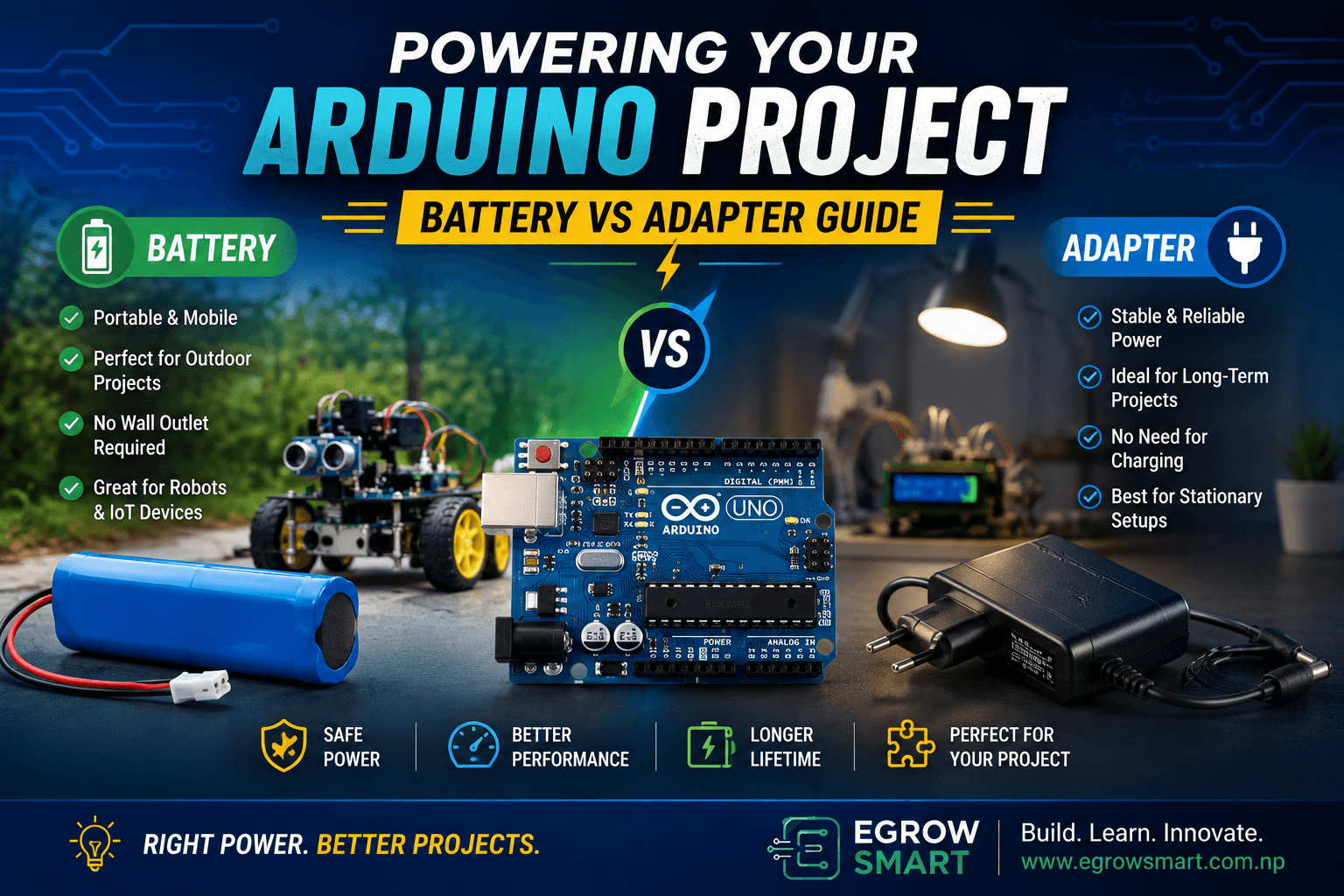
Powering Your Arduino Project: Battery vs Adapter Guide
Choosing the right power source is an important part of building a reliable Arduino project. Whether you're making a robot, weather station, IoT device, or automation system, the wrong power supply can cause unstable operation, unexpected resets, or even damage your components.
In this guide, we'll compare batteries vs adapters for Arduino projects and help you choose the right option.
Battery vs Adapter: What's the Difference?
🔋 Battery
A battery provides portable power, making it ideal for projects that need to operate without being connected to a wall outlet.
Best for:
Mobile robots
Remote sensors
Portable electronics
Outdoor projects
Battery-powered IoT devices
Advantages:
Portable
No mains connection required
Useful for outdoor applications
Easy to integrate into mobile projects
Limitations:
Battery voltage decreases as it discharges
Requires charging or replacement
Capacity and runtime must be considered
🔌 Power Adapter
A power adapter provides a stable power source from an electrical outlet. It is ideal for projects that remain in one location.
Best for:
Home automation
IoT gateways
Weather stations
Displays
Laboratory projects
Long-running Arduino projects
Advantages:
Stable power supply
Suitable for continuous operation
No battery replacement or charging
Convenient for stationary projects
Limitations:
Requires access to an electrical outlet
Not suitable for highly mobile projects
Cable management may be required
Before connecting a power source, always check the required voltage and current of your Arduino board and connected components.
Motors and servos can draw significantly more current than the Arduino itself. For robotics projects, it's often better to use a suitable separate supply for motors while ensuring that the Arduino and motor-control system have a proper common ground where required.
Also remember that higher voltage does not mean better performance. Always stay within the recommended input range for your particular Arduino board.
Final Verdict
Choose a battery when portability and mobility are important. Choose a power adapter when your Arduino project needs reliable, continuous power in a fixed location.
The right power source can make your project safer, more stable, and more reliable.
Build Your Next Arduino Project with Egrow Smart
Looking for Arduino boards, batteries, adapters, sensors, motors, jumper wires, and other electronics components?
Explore Egrow Smart and get the components you need to build, learn, and innovate.
👉 Visit Egrow Smart:
https://egrowsmart.com.np/