
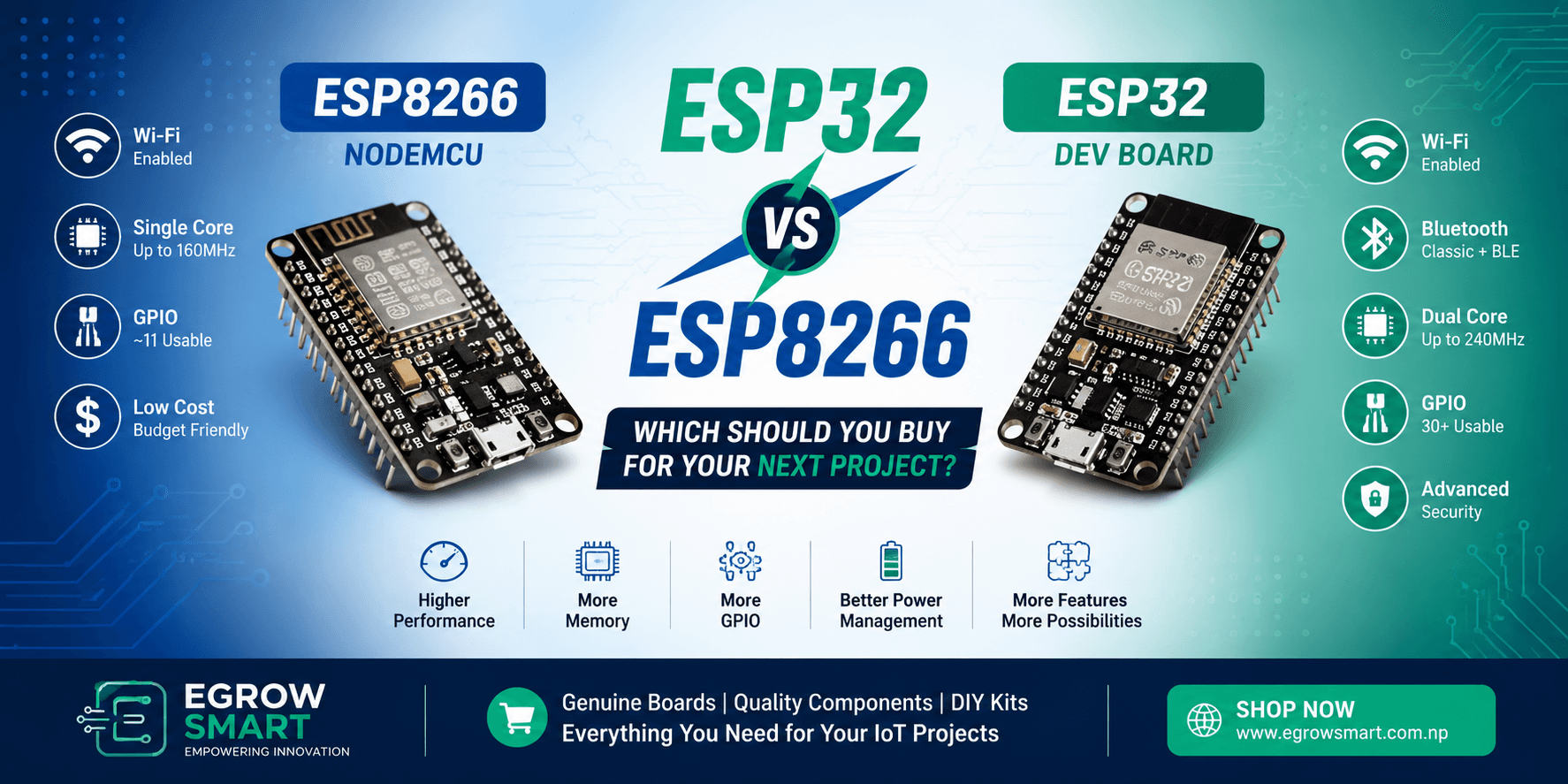
ESP32 vs ESP8266: Which Should You Buy for Your Next Project?
ESP32 vs ESP8266: Which Should You Buy for Your Next Project?
The Internet of Things (IoT) has transformed the way we build smart devices, and two microcontrollers dominate the DIY electronics world: ESP8266 and ESP32. Whether you're creating a home automation system, weather station, smart agriculture project, or robotics application, choosing the right development board is an important first step.
At Egrow Smart, one of the most common questions we receive from beginners and experienced makers alike is:
"Should I buy an ESP8266 or an ESP32?"
The answer depends on your project requirements, budget, and future expansion plans. In this guide, we'll compare both boards in detail so you can confidently choose the right one.
What is ESP8266?
The ESP8266 is a low-cost Wi-Fi-enabled microcontroller developed by Espressif Systems. It became extremely popular because it made wireless IoT development affordable and easy. Even today, it remains one of the best choices for simple Wi-Fi-based projects.
Best suited for:
Home automation
Wi-Fi sensor nodes
Smart switches
Weather monitoring
MQTT communication
Learning IoT basics
What is ESP32?
The ESP32 is the next-generation microcontroller from Espressif. It builds upon the success of the ESP8266 by adding significantly more processing power, memory, GPIO pins, Bluetooth connectivity, and advanced peripherals.
The ESP32 has become the preferred platform for modern IoT, robotics, industrial automation, wearable devices, and smart agriculture projects.
Best suited for:
Smart agriculture
Robotics
Bluetooth devices
Smart displays
Industrial IoT
AI and Edge Computing
Camera-based applications
Performance Comparison
If your project only needs to read a sensor and send data over Wi-Fi, the ESP8266 performs very well.
However, modern IoT applications often require handling multiple tasks simultaneously, such as:
Reading sensors
Updating displays
Communicating with cloud servers
Running web dashboards
Managing Bluetooth devices
This is where the ESP32 truly shines. Its faster processor, larger memory, and dual-core architecture allow it to execute multiple operations efficiently without slowing down.
Winner: ESP32
Wi-Fi and Bluetooth
Both boards provide reliable Wi-Fi connectivity.
The biggest difference is Bluetooth support.
ESP8266
Wi-Fi ✔
Bluetooth ✖
ESP32
Wi-Fi ✔
Bluetooth Classic ✔
Bluetooth Low Energy (BLE) ✔
If your project needs smartphone connectivity, Bluetooth sensors, wireless controllers, or wearable devices, the ESP32 is the clear choice.
Winner: ESP32
GPIO and Peripheral Support
GPIO (General Purpose Input Output) pins allow you to connect sensors, displays, motors, relays, and other electronic components.
ESP8266 offers:
Limited GPIO pins
One ADC channel
Basic PWM support
ESP32 provides:
More than 30 GPIO pins
Multiple ADC channels
DAC outputs
Capacitive touch inputs
Hardware timers
SPI, UART, I²C, CAN, and more
If you're planning to connect multiple sensors or modules, ESP32 gives you much greater flexibility.
Winner: ESP32
Power Consumption
Both development boards support Deep Sleep mode, making them suitable for battery-powered IoT devices.
If your project is a simple sensor node that wakes up occasionally to send data, the ESP8266 is still an excellent low-cost option.
For advanced battery-operated systems requiring Bluetooth or multiple sensors, the ESP32 provides more features while still offering efficient power management.
Programming Experience
Both ESP8266 and ESP32 can be programmed using:
Arduino IDE
PlatformIO
MicroPython
If you're already familiar with Arduino programming, you'll have no difficulty getting started with either board.
Which One Should You Choose?
Choose ESP8266 if:
✔ You are learning IoT for the first time.
✔ You need only Wi-Fi connectivity.
✔ Your budget is limited.
✔ You're building simple automation projects.
✔ You want a reliable and inexpensive development board.
Choose ESP32 if:
✔ You need Bluetooth.
✔ Your project requires more GPIO pins.
✔ You are using multiple sensors.
✔ You need higher processing power.
✔ You're designing robotics or automation systems.
✔ You plan to expand your project in the future.
Popular Projects Using ESP8266
Smart Light Controller
Wi-Fi Weather Station
Smart Energy Meter
IoT Temperature Monitor
Wi-Fi Relay Switch
Home Automation Dashboard
Popular Projects Using ESP32
Smart Greenhouse Monitoring
Face Recognition Door Lock
Bluetooth-Controlled Robot
IoT Weather Station
GPS Vehicle Tracker
Smart Irrigation System
Voice-Controlled Home Automation
ESP32 Camera Surveillance
Price Comparison
If cost is your primary concern, the ESP8266 remains one of the most affordable Wi-Fi microcontrollers available.
However, the price difference between ESP8266 and ESP32 has become relatively small over the years. Considering the additional features, processing power, and Bluetooth capability, the ESP32 often provides better long-term value for new projects.
Our Recommendation
For beginners working on simple Wi-Fi projects, the ESP8266 is still an excellent choice. It is affordable, reliable, and widely supported by the maker community.
However, if you are starting a new project in 2026 and want room for future upgrades, the ESP32 is our recommended choice. Its superior performance, larger memory, Bluetooth support, and extensive GPIO options make it the best investment for most IoT applications.
Shop ESP Development Boards at Egrow Smart
Looking for genuine ESP32 and ESP8266 development boards in Nepal?
At Egrow Smart, we provide high-quality development boards, sensors, displays, modules, and accessories for students, hobbyists, educators, and professionals.
Recommended Products
ESP32 Development Board
ESP8266 NodeMCU
OLED Display Module (0.96")
DHT11 Temperature & Humidity Sensor
Soil Moisture Sensor
Relay Module
Breadboard
Jumper Wire Kit
Servo Motor
Arduino UNO
Explore our complete collection of IoT development boards and electronics components at:
Frequently Asked Questions
Is ESP32 faster than ESP8266?
Yes. ESP32 features a faster processor, larger memory, and better multitasking capability, making it suitable for more demanding applications.
Does ESP8266 support Bluetooth?
No. The ESP8266 supports only Wi-Fi. If Bluetooth is required, choose an ESP32.
Can both boards be programmed using Arduino IDE?
Yes. Both ESP8266 and ESP32 are fully compatible with the Arduino IDE.
Which board is better for beginners?
For learning basic IoT concepts on a tight budget, the ESP8266 is a great starting point. If you plan to build more advanced projects later, beginning with the ESP32 is often the better long-term choice.
Conclusion
Both the ESP8266 and ESP32 have earned their place in the maker community. The ESP8266 remains a reliable, low-cost solution for straightforward Wi-Fi applications, while the ESP32 delivers the performance, connectivity, and flexibility required for today's advanced IoT projects.
If you're still unsure which board fits your project, the team at Egrow Smart is here to help. Browse our range of ESP development boards, sensors, and DIY electronics kits, and let us help you bring your next innovation to life.
Start your IoT journey today with Egrow Smart—your trusted electronics partner in Nepal.