
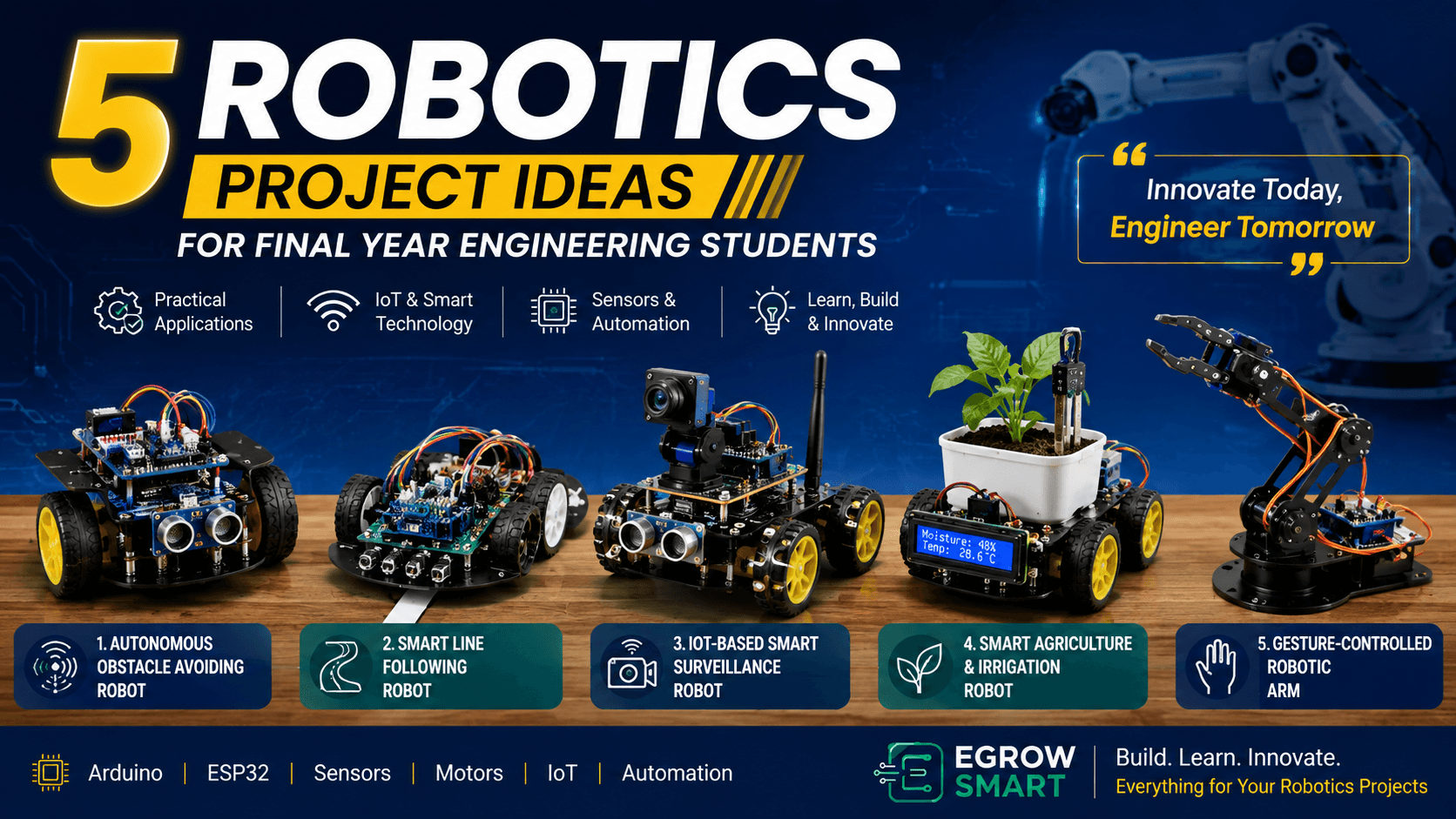
5 Robotics Project Ideas for Final Year Engineering Students
5 Robotics Project Ideas for Final Year Engineering Students
Are you looking for robotics project ideas for final year engineering students? A robotics project is an excellent way to combine electronics, programming, sensors, motors, control systems, and automation into one practical engineering solution.
For a final-year project, you don't necessarily need to build the most complicated robot. A good project should solve a real-world problem, demonstrate your engineering knowledge, and provide opportunities for testing, improvement, and future development.
In this article, we explore 5 practical robotics project ideas that engineering students can build using commonly available components such as Arduino, ESP32, ultrasonic sensors, IR sensors, motors, motor drivers, servo motors, and IoT modules.
1. Autonomous Obstacle Avoiding Robot
An autonomous obstacle avoiding robot is a great project for students who want to learn about sensors, motor control, and autonomous navigation.
The robot uses an ultrasonic sensor to detect obstacles in its path. A microcontroller processes the distance information and controls the motors accordingly.
How It Works
The basic working process is:
Ultrasonic Sensor → Microcontroller → Decision Making → Motor Driver → Motors
When there is no obstacle, the robot moves forward. When an obstacle is detected within a predefined distance, the robot stops, checks for an alternative direction, turns, and continues moving.
Required Components
Arduino Uno or ESP32
HC-SR04 Ultrasonic Sensor
N20 Geared Motors
Motor Driver
Robot Chassis
Wheels
Caster Wheel
Battery
Jumper Wires
Switch
Features You Can Add
To make this project suitable for a final-year engineering project, you can add:
Multiple ultrasonic sensors
Automatic path selection
Bluetooth control
OLED display
Wheel encoders
Speed control
Obstacle mapping
Battery monitoring
This project is especially useful for learning embedded systems, sensor interfacing, PWM, and basic autonomous robotics.
2. Smart Line Following Robot
A line following robot is one of the most popular robotics projects for engineering students. It teaches the fundamentals of sensor-based navigation and motor control.
The robot uses infrared sensors to detect a line on the floor and continuously adjusts the speed of its motors to stay on the path.
How It Works
IR sensors are installed underneath the robot. They detect the difference between the line and the surrounding surface.
The microcontroller processes the sensor signals and controls the left and right motors.
For example:
Line centered → Robot moves forward
Line detected on the left → Robot turns left
Line detected on the right → Robot turns right
No line detected → Robot stops or searches for the path
Required Components
Arduino Uno
IR Line Sensors
N20 Geared Motors
Motor Driver
Robot Chassis
Wheels
Caster Wheel
Battery
Jumper Wires
Advanced Improvements
A basic line follower can be upgraded into a much more advanced engineering project by adding:
PID control
Multiple IR sensors
Variable-speed control
Junction detection
Lap counting
Obstacle detection
OLED display
Bluetooth monitoring
Why Use PID Control?
A simple line-following robot generally uses ON/OFF logic. A more advanced design can use PID control to continuously calculate the required correction.
This allows the robot to follow the line more smoothly and accurately while giving students practical experience with control systems and feedback.
3. IoT-Based Smart Surveillance Robot
Want to combine robotics with IoT?
An IoT-based smart surveillance robot can be an excellent final-year engineering project.
The robot can move around an area while allowing a user to monitor and control it remotely through Wi-Fi.
An ESP32 can be used as the main controller for applications requiring wireless connectivity.
Possible Features
The robot can provide:
Wi-Fi remote control
Camera monitoring
Obstacle detection
Temperature monitoring
OLED status display
Remote movement control
Battery monitoring
Basic System
Sensors + Camera → ESP32 → Wi-Fi → Web/Mobile Interface
The user can control the robot remotely while receiving information from the sensors.
Required Components
ESP32 Development Board
Motor Driver
N20 Geared Motors
Ultrasonic Sensor
ESP32-CAM or compatible camera
OLED Display
Robot Chassis
Battery
Wheels
Jumper Wires
Advanced Features
To increase the technical level of the project, students can add:
Live video streaming
Web-based control
Temperature and humidity monitoring
Cloud data logging
GPS tracking
Mobile application
Automatic obstacle avoidance
Night monitoring
This project is ideal for students interested in IoT, embedded systems, networking, wireless communication, and robotics.
4. Smart Agriculture and Autonomous Irrigation Robot
Agriculture is an important field where robotics and IoT can solve real-world problems.
A smart agriculture robot can monitor soil and environmental conditions and automatically control irrigation when necessary.
Instead of creating only a stationary irrigation system, students can develop a mobile robot that moves around a small agricultural area and collects information from different locations.
How It Works
The robot can measure:
Soil moisture
Temperature
Humidity
Water level
Environmental conditions
The controller processes the sensor readings and activates a water pump when irrigation is required.
Basic System
Soil Moisture Sensor → ESP32/Arduino → Decision → Relay → Water Pump
The robot can also use motors to move around the agricultural area.
Required Components
ESP32 or Arduino
Soil Moisture Sensor
DHT22 Temperature & Humidity Sensor
Motor Driver
N20 Geared Motors
Relay Module
Water Pump
Robot Chassis
Battery
OLED Display
Advanced Features
You can make the project more innovative by adding:
Automatic irrigation
Wi-Fi monitoring
Mobile notifications
Water-level monitoring
GPS
Solar charging
Temperature and humidity logging
Cloud data storage
Automatic navigation
This project combines robotics, IoT, agriculture, sensors, automation, and embedded systems, making it a strong option for a final-year project.
5. Gesture-Controlled Robotic Arm
If you're looking for a more advanced robotics project, a gesture-controlled robotic arm is an interesting choice.
The robotic arm can be controlled using hand movements. An accelerometer and gyroscope such as the MPU6050 can detect changes in orientation, while the microcontroller processes the movement and controls servo motors.
Basic System
MPU6050 → Microcontroller → Servo Motors → Robotic Arm
For example:
Move the controller upward → Arm moves upward
Move downward → Arm moves downward
Rotate the controller → Arm rotates
Change orientation → Gripper or joint responds
Required Components
Arduino Uno or ESP32
MPU6050 Accelerometer/Gyroscope
Servo Motors
Robotic Arm Structure
External Power Supply
Breadboard
Jumper Wires
What You Will Learn
This project provides practical knowledge of:
Accelerometers
Gyroscopes
I²C communication
Servo motor control
Motion detection
Human-machine interaction
Embedded programming
Robotics
Advanced Improvements
For a stronger final-year project, you can add:
Multiple degrees of freedom
Automatic object gripping
Pick-and-place operation
Bluetooth control
Camera integration
Object detection
Inverse kinematics
Automatic positioning
Essential Components for Robotics Projects
You don't need hundreds of components to start building a robotics project.
Some of the most useful components include:
Microcontrollers
Arduino Uno
Arduino Mega
ESP32
ESP8266
Sensors
HC-SR04 Ultrasonic Sensor
IR Sensor
DHT22 Sensor
Soil Moisture Sensor
MPU6050
PIR Sensor
Motors
N20 Geared Motor
DC Motor
Servo Motor
Motor Drivers
L298N Motor Driver
TB6612FNG Motor Driver
Other suitable motor driver modules
Displays and Communication
0.96-inch OLED Display
LCD Display
Bluetooth Modules
ESP32 Wi-Fi
Accessories
Breadboard
Jumper Wires
Battery
Battery Holder
Switches
LEDs
Resistors
How to Make Your Final-Year Robotics Project Successful
1. Start With a Working Prototype
Don't try to build the complete robot on the first day.
Develop your project step by step:
Test Sensor → Test Motor → Test Motor Driver → Combine Hardware → Write Code → Build Robot → Add Advanced Features
This approach makes troubleshooting much easier.
2. Define a Real Problem
A strong engineering project should have a clear problem statement.
Instead of saying:
"We are building a robot."
explain:
"We are developing an autonomous robot to reduce manual monitoring in agricultural fields."
A clear problem makes your project more meaningful.
3. Include Measurable Results
Don't simply state that your robot works.
Measure parameters such as:
Sensor accuracy
Detection distance
Navigation accuracy
Motor speed
Battery backup
Response time
Communication range
Irrigation accuracy
These results make your project more professional and engineering-focused.
4. Leave Room for Future Improvements
Your final project doesn't have to solve every problem.
You can propose future improvements such as:
Artificial intelligence
Computer vision
Cloud computing
Machine learning
GPS navigation
Autonomous mapping
Mobile applications
Solar power
This demonstrates how your prototype could evolve into a real-world product.
Get Robotics Components at Egrow Smart
Building a final-year robotics project is easier when you have the right components.
At Egrow Smart, you can find electronics components and development boards suitable for Arduino, ESP32, IoT, robotics, automation, and engineering projects.
Explore our collection of:
Arduino Boards
ESP32 Development Boards
Sensors
Motors
Motor Drivers
OLED Displays
Robotics Accessories
DIY Electronics Kits
👉 Start building your next engineering project today!
Visit Egrow Smart:
https://egrowsmart.com.np/
Frequently Asked Questions
What is the best robotics project for final-year engineering students?
The best project depends on your skills and interests. IoT surveillance robots, smart agriculture robots, autonomous navigation robots, and robotic arms are excellent choices when properly designed and tested.
Which microcontroller is best for robotics?
Arduino is excellent for basic robotics and motor-control projects. ESP32 is a better option when your project requires Wi-Fi, Bluetooth, IoT connectivity, or more processing capability.
Can I use ESP32 for a robotics project?
Yes. ESP32 is an excellent choice for robotics projects that require Wi-Fi, Bluetooth, remote monitoring, sensors, or IoT functionality.
How can I make a simple robotics project suitable for final year?
Start with a basic working prototype and then add advanced engineering features such as PID control, IoT, wireless communication, data logging, computer vision, autonomous navigation, or AI.
What components are needed for a robotics project?
Common components include a microcontroller, sensors, motors, motor driver, battery, chassis, wheels, jumper wires, and supporting electronic components. The exact components depend on the project.
Conclusion
Robotics provides engineering students with an opportunity to turn classroom knowledge into practical solutions.
The 5 robotics project ideas for final year engineering students discussed in this article cover different areas of robotics, including autonomous navigation, control systems, IoT, smart agriculture, and robotic arms.
Whether you choose an obstacle avoiding robot, line following robot, IoT surveillance robot, smart agriculture robot, or gesture-controlled robotic arm, focus on solving a real problem and producing measurable results.
Start with a simple prototype, test every component, document your development process, and gradually add advanced features.
Build. Learn. Innovate.
Egrow Smart — Powering Innovation Through DIY Electronics.