
Understanding Sensors: Types, Working Principles & Applications
Understanding Sensors: Types, Working Principles & Applications
Modern technology relies heavily on sensors to make devices smarter, safer, and more efficient. From smartphones and smart homes to industrial automation and robotics, sensors play a critical role in collecting real-world data and helping systems respond intelligently.
If you are a student, electronics beginner, Arduino enthusiast, or technology lover, understanding sensors is one of the first steps toward learning electronics and automation.
In this guide, we will explore what sensors are, how they work, different types of sensors, and their real-world applications.
What is a Sensor?
A sensor is an electronic device that detects physical changes in the environment and converts them into electrical signals that a system can understand.
Sensors can detect things such as:
Temperature
Humidity
Light intensity
Motion
Pressure
Distance
Sound
Gas and smoke
In simple words, a sensor acts like the eyes and ears of an electronic system, helping devices understand their surroundings.
For example:
A smartphone automatically adjusts brightness using a light sensor.
A motion detector turns on lights when someone enters a room.
Smart thermostats monitor room temperature.
How Do Sensors Work?
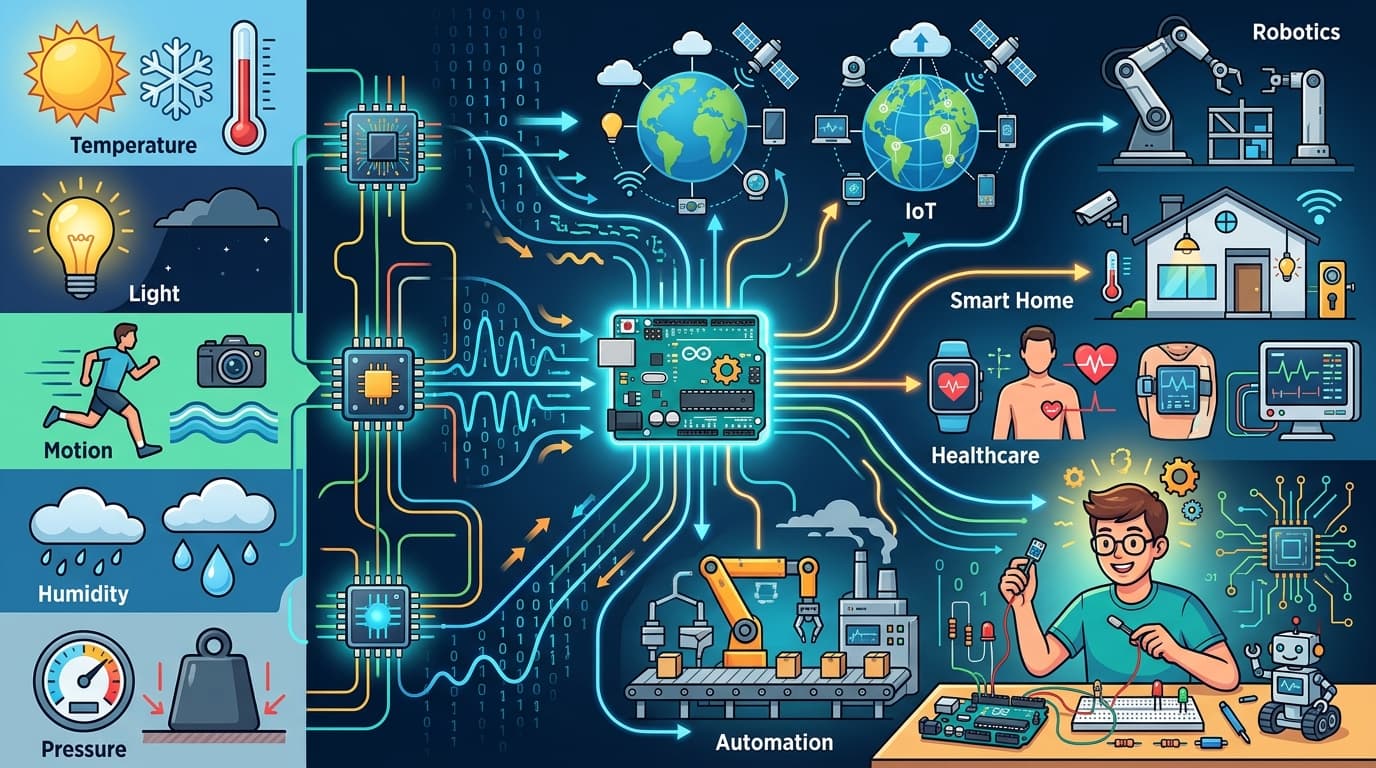
Sensors work by detecting physical changes and converting them into measurable electrical signals.
The basic working process includes:
1. Detection
The sensor detects environmental changes.
Example: A temperature sensor senses heat.
2. Signal Conversion
The physical change is converted into an electrical signal.
3. Processing
A microcontroller (such as Arduino or ESP32) processes the signal.
4. Response
The system reacts based on sensor data.
Example:
A motion sensor detects movement → Arduino processes the signal → Alarm turns ON.
This process is widely used in IoT, robotics, automation, and smart electronics systems.
Types of Sensors
There are many types of sensors used in electronics. Let’s explore the most common ones.
1. Temperature Sensor
Temperature sensors measure heat levels in an environment.
Common examples:
DHT11
DHT22
LM35
Applications:
✔ Weather stations
✔ Smart air conditioning
✔ Temperature monitoring systems
2. Humidity Sensor
Humidity sensors measure moisture in the air.
Popular sensor:
DHT11 Sensor
Applications:
✔ Weather monitoring
✔ Smart farming
✔ Greenhouse systems
3. Motion Sensor
Motion sensors detect movement.
Popular type:
PIR Motion Sensor
Applications:
✔ Smart lighting
✔ Security alarms
✔ Automatic doors
4. Ultrasonic Sensor
Ultrasonic sensors measure distance using sound waves.
Popular sensor:
HC-SR04
Applications:
✔ Obstacle detection robots
✔ Water level monitoring
✔ Parking systems
5. Light Sensor
Light sensors detect brightness.
Examples:
LDR (Light Dependent Resistor)
Applications:
✔ Automatic street lights
✔ Mobile screen brightness adjustment
6. Gas Sensor
Gas sensors detect harmful gases or smoke.
Popular examples:
MQ2 Sensor
MQ135 Sensor
Applications:
✔ Gas leakage detection
✔ Air quality monitoring
7. Pressure Sensor
Pressure sensors measure force applied by liquids or gases.
Applications:
✔ Industrial automation
✔ Medical devices
✔ Weather systems
8. Sound Sensor
Sound sensors detect audio signals and noise levels.
Applications:
✔ Voice-controlled systems
✔ Clap switches
✔ Smart automation
9. Proximity Sensor
Proximity sensors detect nearby objects without physical contact.
Applications:
✔ Smartphones
✔ Touchless switches
✔ Industrial machines
Classification of Sensors
Sensors are mainly classified into two categories:
Active Sensors
Require external power to work.
Examples:
Ultrasonic sensor
Gas sensor
Passive Sensors
Generate signals naturally without external excitation.
Examples:
Thermocouple
Photodiode
Applications of Sensors in Real Life
Sensors are used almost everywhere in modern technology.
Smart Homes
Sensors automate lights, fans, and security systems.
Healthcare
Used in:
Heart monitoring
Temperature monitoring
Wearable health devices
Automotive Industry
Cars use sensors for:
Parking assistance
Speed monitoring
Airbag systems
Robotics
Sensors help robots:
Detect obstacles
Navigate paths
Interact with surroundings
Agriculture
Smart farming uses sensors for:
Soil moisture monitoring
Weather prediction
Irrigation control
Industrial Automation
Factories use sensors for:
Machine monitoring
Safety systems
Process automation
Benefits of Using Sensors
Sensors provide many advantages:
✔ Increased automation
✔ Improved accuracy
✔ Better safety and monitoring
✔ Energy efficiency
✔ Faster decision-making
They are essential for building smart devices and intelligent systems.
Sensors in Arduino and IoT Projects
If you are learning Arduino or IoT, sensors are one of the most exciting parts of electronics projects.
Popular beginner projects include:
Arduino Weather Station
Smart Home Automation
Obstacle Avoiding Robot
Smart Dustbin
Temperature Monitoring System
These projects help students learn coding, electronics, and automation practically.
Future of Sensor Technology
Sensor technology is growing rapidly with advancements in:
Artificial Intelligence (AI)
Internet of Things (IoT)
Smart Cities
Wearable Technology
Robotics
Future sensors will become:
✔ Smaller
✔ Faster
✔ More accurate
✔ More energy-efficient
They will continue to shape the future of smart living and automation.
Final Thoughts
Sensors are one of the most important building blocks of modern electronics and smart technology. They help machines collect information from the environment and make intelligent decisions.
Whether you are interested in Arduino, robotics, IoT, smart homes, or automation, learning about sensors is essential for building innovative projects.
Start experimenting with different sensors today and unlock endless possibilities in electronics and technology!